Guides · October 7, 2026 · By Dayne Remlinger
How much vinyl does it take to wrap a vehicle?
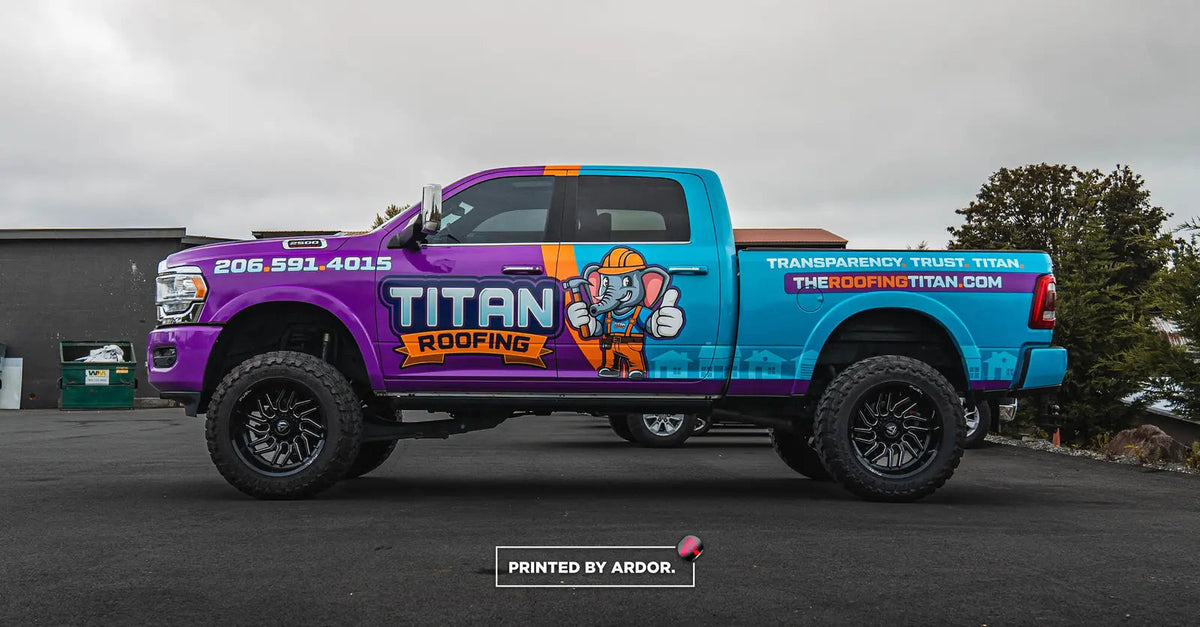
How much vinyl to wrap a car, van or truck depends on the vehicle in front of you and on how the printer bills. Charts that give one number per vehicle class are rough guides at best, because trim levels, roof heights and wheelbases change the measurements. This guide shows the method wrap shops can use on any vehicle: measure each surface, add bleed, then convert the pieces into billed square feet on a 60 inch roll.
Two numbers: graphic area and billed vinyl
Every wrap has two square-foot numbers. The first is the area of the graphics. The second is the vinyl that runs through the printer. Wholesale wrap printing is billed on the second one. At WrapPrinting.com, wrap film prints on 60 inch rolls with a 58 inch maximum print width, and each panel is billed at the full 60 inch roll width times its length. A 48 x 120 inch graphic is billed as 60 x 120 inches, which is 50 sq ft, not 40.
So the real question is how many inches of roll the job uses.
Step 1: measure each surface
Measure the actual vehicle, not a template. Take the widest and tallest point of each surface you plan to cover and write down width and height in inches:
- Driver side and passenger side, measured separately
- Rear, including doors or tailgate
- Hood
- Roof, if the job includes it
- Front and rear bumpers
Step 2: add bleed
Our file setup guide asks for at least 2 inches of bleed on every edge of vehicle artwork. That adds 4 inches to each dimension. A side that measures 160 x 68 inches becomes a 164 x 72 inch piece.
Step 3: turn each piece into inches of roll
Take each piece, with bleed, and work out how it fits a 58 inch print width:
- One dimension is 58 inches or less. The piece prints as one panel. The roll length used is the other dimension.
- Both dimensions are over 58 inches. The piece has to be paneled. Divide one dimension by 58 and round up to get the number of panels, then multiply by the other dimension. Do it both ways and keep the smaller result. We panel in the direction that uses the least material.
- Small pieces. Pieces nest side by side across the roll when their widths add up to 58 inches or less. They then share one length of roll.
Add up the inches of roll, multiply by 60, and divide by 144. That is the billed square footage.
Worked example 1: full wrap on a cargo van
These are example dimensions chosen to show the math. They are not the measurements of any particular van.
- Each side: 160 x 68 inches, 164 x 72 with bleed. Vertical panels: 164 divided by 58 rounds up to 3 panels, each 72 inches long, for 216 inches of roll. Horizontal panels would take 2 panels at 164 inches, or 328 inches. Vertical wins. Two sides use 432 inches.
- Rear doors: 62 x 60 inches, 66 x 64 with bleed. Two panels either way. Running the 64 inch dimension along the roll uses 128 inches. The other direction uses 132.
- Hood: 60 x 36 inches, 64 x 40 with bleed. The 40 inch dimension fits the print width, so it is one panel and 64 inches of roll.
- Bumpers: front 72 x 14 and rear 66 x 10 inches, which become 76 x 18 and 70 x 14 with bleed. Their widths add up to 32 inches, so they nest side by side and share 76 inches of roll.
Total roll: 432 + 128 + 64 + 76 = 700 inches. Billed vinyl: 700 x 60 / 144 = 291.7 sq ft. The graphics themselves cover about 203.5 sq ft. The difference is bleed, the unprinted edge of the roll and panel rounding, and it is why quoting from graphic area alone comes up short.
Worked example 2: partial wrap on a pickup
Again, example dimensions only.
- Two side graphics: 96 x 24 inches each, 100 x 28 with bleed. Two 28 inch pieces add up to 56 inches, so they nest across the roll and share 100 inches of roll.
- Tailgate: 58 x 20 inches, 62 x 24 with bleed. One panel, 62 inches of roll.
Total roll: 162 inches. Billed vinyl: 162 x 60 / 144 = 67.5 sq ft, for about 40 sq ft of graphics.
Now make the side graphics 30 inches tall instead of 24. With bleed they are 34 inches each, and two of them no longer fit across 58 inches. Each side needs its own 100 inches of roll, and the job goes from 162 inches to 262 inches, or 109.2 sq ft. Six inches of design height added more than 40 sq ft of vinyl, so check the nesting before the design is final.
What the estimate leaves out
The method above does not include panel overlap. When we panel a file we add overlap and show the layout on the proof, so the proof is the final number. Roofs, mirrors and door jambs add more pieces if the job includes them. If you panel the file yourself, keep every panel at 58 inches or less including overlap.
From square feet to a price
Multiply the billed square feet by the price of the film. Printed Avery MPI 1105 and printed 3M IJ180Cv3 are both $5.27 per sq ft, laminated, trimmed and paneled. Volume pricing is automatic: 5% off at 1,000 sq ft, 7% at 1,500 and 10% at 2,000.
You do not have to do the math by hand. Use the wrap printing price calculator, or enter your sizes on a product page to see billed square footage before you order. How wholesale wrap printing is measured covers roll width, paneling and nesting in more detail, and all current rates are on the pricing page.
Price your next job
Published per-square-foot pricing on Avery and 3M films. Printed in-house by Ardor Printing and shipped 2 business days after proof approval.